Last Saturday, I stood in my Denver bedroom wearing one sneaker, two jackets, and the expression of someone who had somehow made a two-night trip complicated. Scout watched from the rug while I argued with a carry-on. A good weekend capsule edit should prevent exactly this sort of nonsense. It is not about owning fewer clothes or dressing like a minimalist in a linen catalog. It is about choosing a small group of pieces that can handle coffee, a long drive, dinner, and the unexpected weather shift without requiring a costume change every three hours.
Start with the actual weekend
Before choosing a single garment, look at the itinerary. A cabin weekend, a city visit, and a family gathering need different clothes. The best weekend capsule edit begins with three questions: How much walking will happen? What is the forecast? Is there one occasion that needs a slightly more polished outfit?
For a typical two-night trip, I usually plan one travel outfit, two daytime looks, one dinner option, and sleepwear. That does not mean packing four complete outfits. A dark straight-leg jean can travel on Friday, work with a sweater on Saturday morning, and pair with a silk or satin blouse at night. A cotton button-down can sit open over a tank, tuck into trousers, or function as a light layer over a dress.
This is where honest wardrobe math helps. If one top only works with one bottom, it is taking up valuable suitcase real estate. If a jacket works with everything you packed, it has earned its place. I learned to judge garments by combinations rather than individual charm after years of seeing racks of beautiful pieces that were impossible to sell as a working wardrobe.
The five-piece foundation
My reliable weekend capsule edit usually starts with five anchors: one comfortable bottom, one alternative bottom, two tops, and one third piece. The first bottom might be a pair of Madewell jeans, Levi's 501s, or soft wide-leg trousers from Everlane. Choose the shape you already enjoy wearing, not the silhouette currently shouting at you from every store window.
The second bottom can change the mood. A slip skirt, pull-on trouser, denim short, or knit pant gives you variety without creating a suitcase full of decisions. For tops, I like one fitted layer and one relaxed layer. A ribbed tank or fine-gauge tee balances an oversized shirt, cardigan, or lightweight sweater.
The third piece does most of the visual work. This could be a cropped utility jacket, an unstructured blazer, a denim jacket, or a cardigan that does not look like it belongs exclusively beside a desk. Look for pockets, a sleeve you can push up, and fabric that survives being folded. The difference between a $45 cotton jacket and a $250 blazer is not automatically quality; inspect the seams, lining, buttons, and how often you can imagine wearing it.
Shoes and accessories that earn their space
Shoes are where weekend packing goes sideways. I generally recommend two pairs, not three: one walking-friendly pair and one option that feels intentional for dinner. Clean leather sneakers from brands such as Veja, Adidas, or New Balance can cover travel and sightseeing. For the second pair, consider loafers, flat sandals, ankle boots, or a low block heel, depending on the season and itinerary.
Wear the larger or heavier pair during travel. That small decision can free enough space for a real sweater rather than the thin emergency cardigan that never gets worn. Test both pairs before leaving home. A shoe that is comfortable for twenty minutes in a bedroom can become a personal grievance after six hours on pavement.
Accessories should solve problems. A crossbody bag keeps your hands free, while a compact tote handles a farmers market stop or an extra layer. Add one belt, one pair of sunglasses, and jewelry you can sleepily put on in a hotel bathroom. In my weekend capsule edit, accessories are not decoration added at the end; they are the tools that make repeated outfits feel deliberate.
Color without making everything beige
A useful palette needs contrast, but it does not have to be neutral. Pick two dependable base colors and one accent. Navy with cream and red works beautifully. Black with denim and green has more personality. Chocolate brown with ivory and blue feels softer than a head-to-toe black plan.
The trick is repeating one color at least twice. If your sweater is burgundy, bring a lip color, sock, scarf, or bag in a related tone. If the only bright item is a yellow skirt that matches nothing else, it is probably an outfit rather than a versatile packing choice. There is nothing wrong with packing an outfit piece, especially for a birthday dinner, but know what it is doing.
A weekend capsule edit should also account for temperature. Denver can move from sunny afternoon to chilly evening with very little warning, while coastal destinations often feel cooler than their forecast suggests. A thin merino sweater, cotton overshirt, or packable vest is more useful than a bulky jacket that dominates the bag.

A sample two-night plan
Here is a practical example for a spring city weekend: dark jeans, a fluid black trouser, a white tee, a striped button-down, a lightweight navy jacket, a merino sweater, sneakers, loafers, sleepwear, and undergarments. The travel look is jeans, tee, jacket, and sneakers. Saturday daytime becomes the trousers with the striped shirt and loafers. Dinner is the black trouser with the tee, jacket, and earrings. Sunday uses the jeans with the sweater.
That is four distinct looks from seven clothing pieces, and none requires a heroic level of styling. If rain is likely, swap the loafers for weather-friendly boots. If the trip includes a formal event, replace the trousers with a simple dress and let the jacket do double duty.
My cost-per-wear brain likes this approach because it exposes weak purchases quickly. A $120 sweater worn eight times on one trip and throughout the season is doing better work than a $300 statement top worn once. Price is only one part of the equation; comfort, construction, laundering, and repeat use matter just as much.
Pack, check, and leave the house
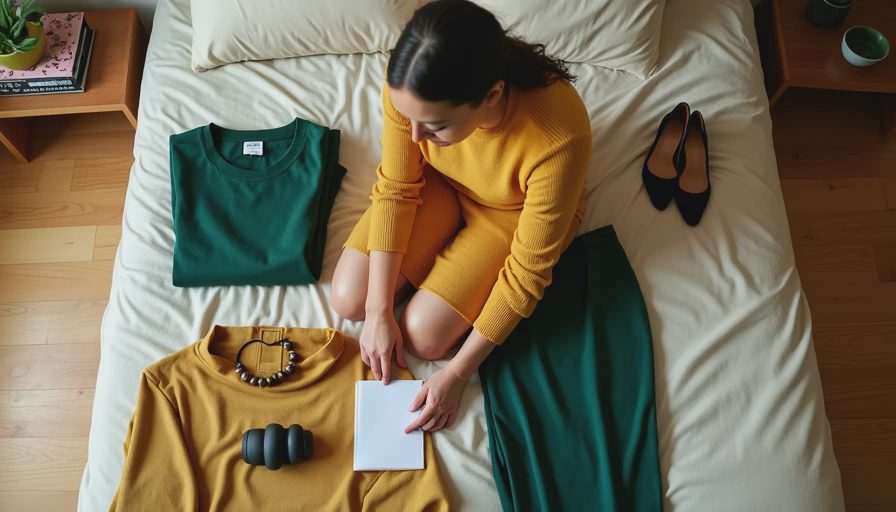
Lay everything on the bed before putting it in the bag. Build each outfit completely, including shoes and jewelry. Take a quick phone photo of combinations that work. Then remove one item, usually the backup top or fantasy activity piece. If a garment requires special underwear, a steamer, and perfect weather, it probably is not the hero of this trip.
Keep a small laundry pouch, a stain stick, and a foldable tote in the bag. These are unglamorous, but they handle spilled coffee and unexpected shopping better than another blouse. Roll soft knits and fold structured pieces. Put shoes in washable bags, and use them to hold socks or chargers.
The point of a weekend capsule edit is not to create rules you can fail. It is to make getting dressed easier when your attention belongs somewhere else: a new neighborhood, a long conversation, a trail, or the second brewery on James's spreadsheet. Choose pieces that let you move through the weekend comfortably and feel like yourself in every photo. Then close the suitcase, wear it and go.
No notes yet — write the first one.