Last winter, I stood in my closet before a pottery class, wearing the same black wool cardigan I had bought years earlier at Nordstrom. I remembered paying $168 for it and feeling slightly ridiculous at the time. Then I did the math. After at least 80 wears, it had cost me about $2.10 per outing. That is cost per wear explained in the most useful way: the price tag is only the beginning of the story.
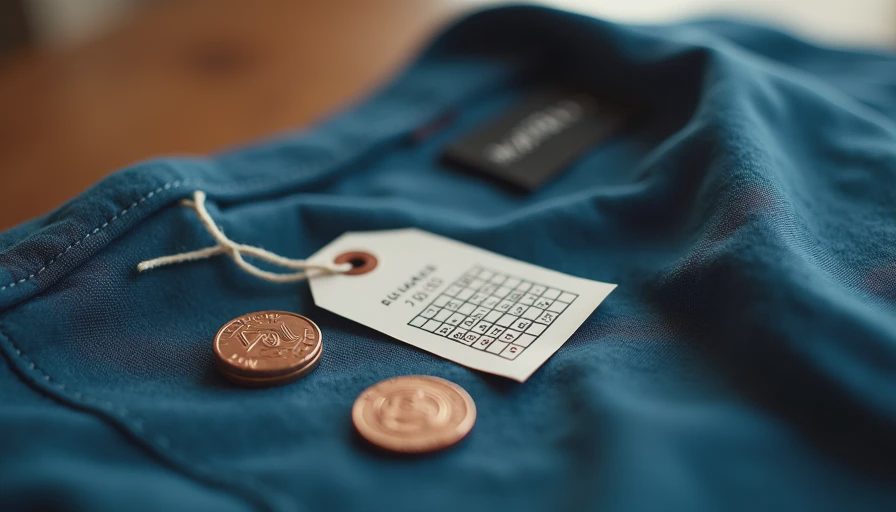
Cost per wear explained simply means dividing what you paid for a garment by the number of times you use it. A $40 dress worn once costs $40 per wear. A $220 blazer worn 30 times costs about $7.33 per wear. The less expensive item is not automatically the better buy, especially if it sits in the back of your closet with the tags still attached.
The simple cost-per-wear formula
The formula is straightforward: purchase price divided by number of wears equals cost per wear. If you spend $120 on leather loafers and wear them 24 times, the calculation is $120 divided by 24, or $5 per wear. If you wear them 60 times over several years, the cost drops to $2 per wear.
You can include alterations in the original price because they are part of making the garment useful. A $95 pair of trousers with a $20 hem has a real starting cost of $115. If you wear them 23 times, they cost $5 per wear. Shipping, cleaning, and repairs can be added when they are unusually expensive, but I usually keep the basic calculation simple. The goal is not accounting perfection. It is making a clearer decision before the return window closes.
Cost per wear explained this way also helps with sale psychology. A $70 sweater marked down from $140 is not a bargain if you only like it in theory. The relevant question is whether you will reach for it on an ordinary Tuesday, not whether the red sticker looks exciting.
Why price alone gives you bad wardrobe math
I have seen thousands of garments up close, and the cheapest item is often the one that costs the most emotionally. A $25 blouse that wrinkles instantly, pulls across the buttons, or requires a complicated undergarment may technically be affordable. If you avoid wearing it, its cost per wear stays high. A $150 blouse in a washable fabric that works with jeans, trousers, and a skirt can become the more practical purchase.
This does not mean every expensive item is worth buying. A $400 trend piece can still be a $400 mistake if it only works with one outfit or feels wrong after lunch. Cost per wear is a tool, not a permission slip. It should support your judgment, not talk you into spending money you do not have.
Think about the life of the garment. Does it suit your actual schedule? Can you sit, walk, work, travel, or pick up a child in it? Does it handle Denver weather, including a sunny morning and a cold evening? The best purchases earn repeat wears because they cooperate with your life.
Real examples from a working closet
Here is cost per wear explained with a few wardrobe examples. A $35 fast-fashion top worn twice costs $17.50 per wear. A $90 cotton shirt worn 25 times costs $3.60 per wear. A $260 wool coat worn 65 times across three winters costs $4 per wear. The coat had the highest starting price, but it delivered the lowest daily expense among the three.
Now consider a $145 pair of jeans. If the fit is comfortable and the wash works with your existing shoes and sweaters, 40 wears brings the cost to $3.63 per wear. If the waistband digs in and you stop wearing them after three attempts, the real cost is $48.33 per wear. No amount of denim marketing can rescue that purchase.
You can also compare categories differently. Special-occasion clothing often has a higher cost per wear because weddings, parties, and formal dinners are less frequent. That is not automatically wasteful. A dress that makes you feel comfortable and polished for five important events may serve its purpose. You just should not compare it directly with your favorite everyday sneakers without considering how each item fits your life.
How to estimate wears before you buy
You do not need a crystal ball. Start by naming three occasions in the next month when you could wear the item. For a blazer, that might be a client meeting, dinner, and jeans-and-sneakers Friday. For a dress, it could be work, a birthday dinner, and a trip. If you cannot identify even two realistic uses, pause.
Next, check compatibility. Hold the item against shoes, layers, and bottoms you already own. A camel cardigan that works with black pants, blue jeans, olive trousers, and a denim skirt has more earning potential than a bright top that requires a specific pair of shoes. Notice fabric care, too. Dry-clean-only pieces can still be excellent purchases, but frequent cleaning adds time and money.
Finally, imagine the boring version of your week. If the item only looks appealing with a full blowout, perfect weather, and an empty schedule, your estimate is probably too optimistic. Cost per wear explained honestly includes the days when you are tired and need clothes to behave.
A better way to track your purchases
I keep a simple cost-per-wear tally on my phone for pieces over $100. I record the item, price, purchase date, and each month’s rough wear count. You can do the same in a notes app without turning your closet into a spreadsheet project. A quick tally after laundry day is enough.
At three months, look for patterns. The items with falling costs are usually easy to style, comfortable, and appropriate for more than one part of your life. The stalled items reveal useful information. Maybe the color does not work with your wardrobe. Maybe the cut needs tailoring. Maybe you bought for an imaginary lifestyle involving more galas than your calendar actually contains.
If an item is not working, do not keep wearing it just to improve the math. Return it if possible, alter it if a small fix will help, or sell and move on. A purchase does not become wise simply because you feel guilty about it.

When a higher price is worth it
A higher price can make sense when it buys something concrete: better fabric, stronger stitching, useful lining, repairability, or a fit you can wear for hours. My wool cardigan was not valuable because it carried a certain label. It was valuable because the knit held its shape, the buttons stayed secure, and it worked over dresses and T-shirts.
Still, quality is not guaranteed by a premium price. Compare seams, zippers, fabric weight, and care instructions. Check whether the item feels comfortable while moving, not just while standing in a fitting room. Brands such as Madewell, Everlane, J.Crew, and Uniqlo all offer different price points and construction choices across their ranges, so inspect the individual garment rather than relying on the name.
The most useful cost per wear explained takeaway is this: buy for repeated use, not for the emotional rush of getting something new. A $60 piece you wear weekly can outperform a $300 piece you admire occasionally. A $300 coat that carries you through five winters can outperform five forgettable $60 coats. The math follows your habits.
Use the math, then wear the clothes
Cost per wear explained without real life is just division. The real test is whether a garment helps you get dressed and go. Before buying, ask what you will wear it with, where it will go, and how often you can honestly imagine reaching for it. Then give yourself permission to choose the $40 skirt, the $220 jacket, or nothing at all.
Your closet does not need to be tiny, perfectly neutral, or approved by anyone online. It needs clothes that support the life you are already living. Track the numbers if they help, learn from the misses, and stop treating a higher price as either automatically wise or automatically foolish. Wear it and go.





No notes yet — write the first one.