A few winters ago, I stood in my Denver bedroom wearing a $248 wool sweater and holding a $68 one from another brand. James was waiting for me to pick a coat so we could meet friends for a beer, and Scout was trying to eat the sweater tag. This is what a Nordstrom buyer knows about clothing quality: the expensive piece is not automatically the better piece. You have to look closely, touch the fabric, and imagine the garment after a year of actual living.
After seven years buying contemporary women's apparel for Nordstrom, I have inspected thousands of garments before they reached a sales floor. I learned to spot thoughtful construction, attractive shortcuts, and prices that mostly pay for a name. You do not need a designer wardrobe or a closet full of natural fibers. You need a few reliable ways to decide whether a piece deserves your money.
Start with the fabric, not the label
The first thing I check is the fabric in my hand. Does it feel dense enough for its intended use? Does it recover after I gently stretch it? For a T-shirt, I look for a knit that is smooth and opaque without feeling stiff. A $25 cotton tee can be excellent if the yarn, weight, and finishing are good. A $95 tee can be disappointing if it is thin, twists after washing, or relies on a logo to do the selling.
For sweaters, fiber content gives you a starting point, not a final answer. Merino wool, cashmere, cotton, alpaca, linen, and silk each have useful qualities, but blends can be smart. Nylon can add durability to a sweater. A little elastane can help a woven pant move with you. Polyester is not automatically cheap; it can perform well in a rain shell, pleated blouse, or washable work dress. What a Nordstrom buyer knows about clothing quality is that the question is not simply natural versus synthetic. It is whether the fiber suits the job.
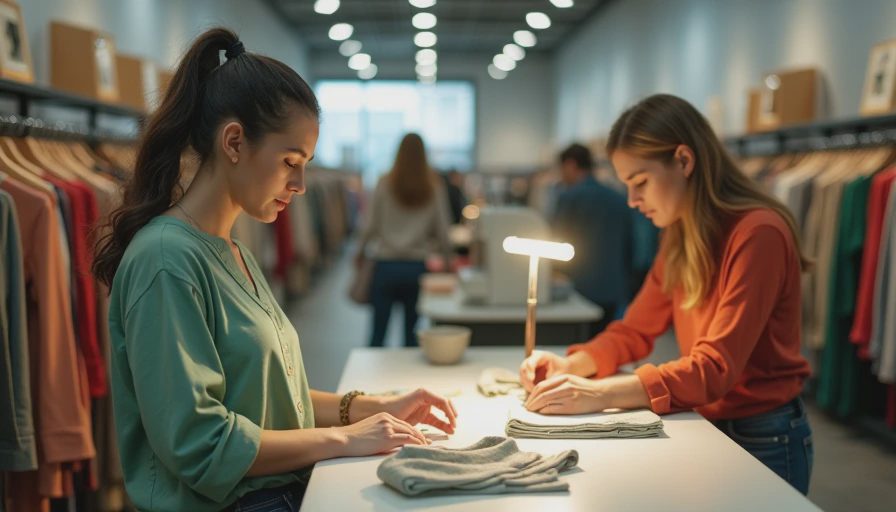
Check the fabric under bright fitting-room light. Hold a dark trouser against your hand to see whether it is translucent. Scrunch a blazer sleeve and watch how quickly it rebounds. Look at the underside of a printed dress. If the pattern looks sharp on both sides, the maker likely paid attention to the textile rather than using a thin surface print.
Construction tells you where the money went
Turn the garment inside out. This is where the conversation gets much more honest. Seams should be reasonably straight, secure, and appropriate for the fabric. On a lined jacket, the lining should sit smoothly without pulling at the armholes. A skirt with a zipper that waves or a waistband that rolls is already asking for tailoring before you have worn it once.
Buttonholes deserve a quick inspection. They should be cleanly finished, with enough room for the button but not so much that the front gaps. Buttons should be attached securely, and a spare button is a useful little sign that someone considered the garment's future. On jeans, check the fly, belt loops, and pocket bags. Heavy denim can still have weak stitching, while a moderately priced pair can hold up beautifully when the stress points are reinforced.
One of the clearest lessons in what a Nordstrom buyer knows about clothing quality is that finish matters more than drama. A simple cardigan with tidy seams, stable ribbing, and a good shoulder line can outlast a complicated statement piece with loose threads and rushed details. I would rather pay $120 for the quiet cardigan I wear twice a week than $220 for a trendy top that needs constant babysitting.
Fit is part of quality
A well-made garment can still be wrong for your body, your movement, or your day. That is not a failure on your part. Clothing is built around samples and averages, while real bodies are wonderfully specific. Quality includes whether a piece lets you sit, reach, walk, and breathe without fighting it.
In a fitting room, sit down in the pants. Lift your arms in the blouse. Walk ten steps in the shoes. Check whether a jacket collar stays flat when you move. If you would need three alterations to make the item comfortable, include that cost before deciding. A $180 dress that needs a $65 hem and $45 strap adjustment is really a $290 purchase, before tax.
I also look at proportion. Does the pocket land where you can use it? Does the sleeve end at a place that works with your watch or bracelets? Is the rise comfortable when you are driving? What a Nordstrom buyer knows about clothing quality includes this practical truth: an item that only works while you stand perfectly still is not high quality for real life.
Price should make sense per wear
I keep a cost-per-wear note on my phone for pieces over $100, partly because I am a former buyer and partly because James enjoys spreadsheets far too much. A $150 pair of trousers worn 30 times costs $5 per wear. A $60 blouse worn twice costs $30 per wear, even if the original price feels safer.
That math does not mean every expensive piece is a wise purchase. It means you should ask how often the item fits your existing life. A beautiful silk dress may be worth $300 if you attend events regularly and can wear it with a cardigan, boots, or sandals. It is not a bargain if it stays in the garment bag because the fabric wrinkles quickly and the occasion never arrives.
What a Nordstrom buyer knows about clothing quality is that a fair price reflects several things: fabric, labor, construction, design, and how often you will reach for it. Brands such as Madewell, J.Crew, Vince, Everlane, and COS can each offer strong pieces, but none is perfect across every category. Inspect the actual garment in front of you. A brand reputation is a useful clue, not a substitute for looking.

The wash test starts before checkout
Care instructions are part of the buying decision. If a sweater says dry clean only, ask whether you are genuinely willing to maintain it. If a washable blouse needs a special cycle, a drying rack, and careful pressing, calculate the time as well as the money. I own delicate pieces, but I buy them intentionally rather than pretending they are easy basics.
Look for shrinkage risk in loosely knit cotton, color transfer in dark denim, and fabric that feels overly soft because it has been aggressively treated. At home, wash according to the label and take a close look afterward. Did the side seams twist? Did the collar ripple? Did the surface pill immediately? One wash does not tell you everything, but it reveals problems that a flattering store light can hide.
For online orders, read the fiber content, garment measurements, and care instructions before adding to cart. Customer reviews are most helpful when several people mention the same concrete issue, such as a zipper catching or sleeves running short. “Cute but thin” is a useful warning if you are shopping for a winter layer.
A buyer's final dressing-room check
Before paying, I do one slow inspection. I check the fabric in natural or bright light, turn the garment inside out, test the closures, sit and move, and picture at least three outfits with clothes I already own. I ask whether I would still want it without the styling on the mannequin. If the answer depends on buying new shoes, a different bra, and a special occasion, the total price is higher than the tag suggests.
I also give myself permission to buy inexpensive clothes when they do their job well. A $30 cotton tank, $45 sweatshirt, or $70 pair of everyday jeans can be a smart purchase when the fit works and the construction is sound. What a Nordstrom buyer knows about clothing quality is not a command to spend more. It is an invitation to notice more.
The best garment is the one that supports the life you already have. Inspect it, price it honestly, and let it earn its place through wear rather than hype. Then put it on, grab your coffee, and go live your day. Wear it and go.


No notes yet — write the first one.