Last month, I stood in a fitting room with a $198 cotton cardigan on one arm and a $49 version on the other. Both looked lovely under flattering store lights. Five minutes of touching, stretching, and inspecting seams told a different story. This is the useful part of fabric quality vs price tag: the number on the hangtag gives you a starting point, not the answer.
After seven years buying contemporary clothing for Nordstrom, I have handled thousands of garments before they reached a sales floor. I have seen expensive pieces pill after three wears and inexpensive cotton shirts become weekly favorites for years. Price can reflect better materials and construction, but it can also reflect branding, retail markup, or a fashionable label. Your job is to figure out which one you are paying for.
What fabric quality actually feels like
Start with the fiber content, but do not stop there. Natural fibers such as cotton, linen, wool, silk, and cashmere have distinct strengths. A tightly woven cotton poplin usually feels crisp and holds its shape. Linen wrinkles, but good linen feels substantial rather than papery. Merino wool can be soft, breathable, and surprisingly durable. Silk should have a smooth, fluid hand instead of feeling slick and flimsy.
Synthetic fibers are not automatically bad news. Polyester can add durability to a work dress, elastane gives jeans comfortable stretch, and nylon makes activewear practical. The question is whether the fiber serves the garment. A small amount of nylon in a sweater can help it hold up; a thin, shiny polyester lining in an otherwise expensive jacket can feel like a shortcut.
Run the fabric through your fingers. Hold it toward the light. If a dark knit looks nearly transparent when stretched, it may not have enough density for regular wear. Scrunch a sleeve and release it. Quality fabric often recovers cleanly, while weak fabric stays crushed or develops a shiny pressure mark.
The construction clues hiding in plain sight
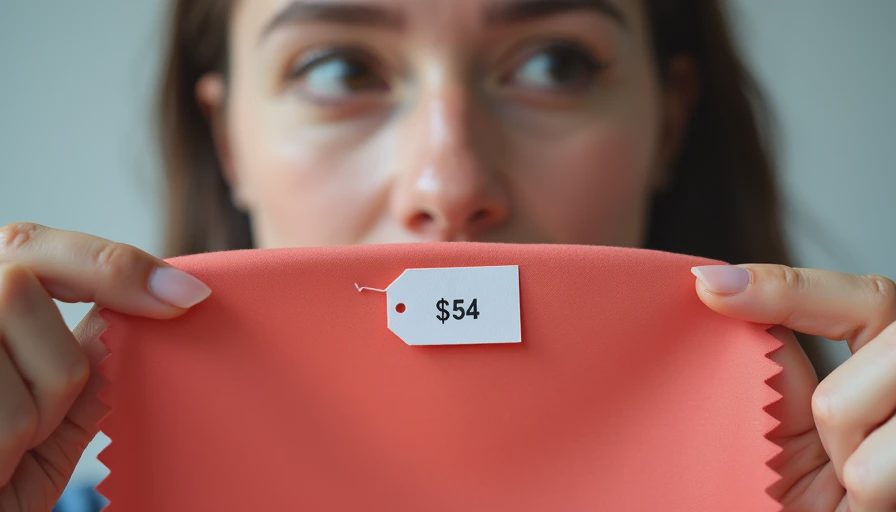
When comparing fabric quality vs price tag, inspect what holds the fabric together. Seams should look even, with no loose threads or skipped stitches. On a blouse, pattern matching at the center front and side seams shows that someone paid attention to cutting and production. It is not mandatory on every garment, but obvious mismatches can signal rushed construction.
Check the inside, because that is where a garment tells the truth. A lined blazer should have a lining that moves comfortably rather than pulling at the armholes. A skirt with a zipper should lie flat around the zipper tape. Buttonholes should be cleanly finished, and buttons should feel securely attached. For jeans, look at the pocket bags, belt loops, and crotch seam. Those are high-stress areas, and weak stitching there turns a bargain into a donation quickly.
Price matters more when construction is complicated. A $120 wool coat with a proper lining, shaped seams, and sturdy hardware can be a better purchase than a $70 unlined coat that loses its shape by February. For a simple tank top, the difference between $28 and $58 deserves more scrutiny. You are not paying for complicated tailoring, so the fabric and fit need to carry the value.
Do the cost-per-wear math
The most honest way to think about fabric quality vs price tag is cost per wear. A $240 trouser worn 40 times costs $6 per wear. A $65 pair worn twice costs $32.50 per wear, even before you account for the annoyance of replacing it. This does not mean every expensive item is smart. It means the purchase should match your actual life.
Imagine two everyday sweaters. The first costs $85, pills under the arms, and gets worn six times before you stop reaching for it. Its cost per wear is about $14. The second costs $170, feels good under a coat, survives two winters, and gets worn 35 times. That is less than $5 per wear. The second wins, but only if its color, neckline, and fit work with clothes you already own.
I keep a simple tally on my phone for purchases over $100. A cream sweater I bought years ago seemed extravagant at the time. It has appeared at client appointments, brewery dinners, and snowy weekend errands. It has earned its price many times over. A beautiful statement skirt at roughly the same price still has a high cost per wear because I rarely have a reason to put it on.
When a lower price is completely reasonable
Not every garment needs heirloom construction. A $15 cotton T-shirt can be a sensible purchase if you want a casual layer for gardening, travel, or messy pottery work. You do not need to spend $90 on something that will be washed constantly and replaced when your preferences change. The right question is whether the item performs well enough for its assignment.
Lower-priced clothing can also be excellent for trend experiments. If you are curious about wide-leg cargo pants or a bright red cardigan, a modest purchase lets you test the idea without turning your closet into a museum of expensive mistakes. Look for good return policies, straightforward care instructions, and fabric that does not feel weak just because the price is low.
Retailers such as Uniqlo, Madewell, J.Crew, and Quince often sit in different parts of the price spectrum while offering useful basics at particular price points. That does not make every item from any brand automatically worthwhile. Inspect the actual garment. A sale price is only a bargain if you wanted the item before the red markdown sign appeared.
When the higher price is worth considering
Spend more when the garment gets hard use, needs structure, or is expensive to replace. A wool coat, leather boots, a work blazer, and jeans you wear three times a week deserve more inspection and potentially a larger budget. Better zippers, dense fabric, reinforced seams, and replaceable buttons can keep those pieces in rotation.
Brand reputation can help, but it is not proof. A designer label may indicate skilled production, or it may simply charge more for recognition. Ask what you can see and feel. Does the jacket hold its shape? Are the seams comfortable? Does the fabric suit the weather where you live? A $300 coat that is too warm for Denver's shoulder seasons or too delicate for your commute is not a successful purchase.
Fabric quality vs price tag becomes especially useful during sales. A 30 percent discount can improve the math on a well-made item, but a 70 percent discount does not rescue poor fit. Try sitting, reaching, walking, and wearing the shoes for a few minutes. The garment has to function outside the mirror.
A five-minute dressing-room test
Before buying, use this sequence. First, read the fiber label and consider whether it makes sense for the garment. Second, stretch the fabric gently and see if it recovers. Third, inspect seams, hems, buttons, zippers, and lining. Fourth, move normally: sit down, raise your arms, and take a few steps. Fifth, picture three real outfits and at least three occasions when you would wear it.
Then compare the likely number of wears with the price. If the result feels reasonable and the care routine fits your schedule, you have useful evidence. If you are already imagining special handling, constant ironing, or a body that needs to change before the garment works, leave it on the hanger. Your wardrobe should support your life as it is.
The best choice is not always the cheapest or the most luxurious. Fabric quality vs price tag is a tool for noticing value, not a rule that tells you what to spend. Buy the sturdy coat when you need one, the ordinary T-shirt when that is enough, and the piece that makes getting dressed easier. Then wear it and go.




No notes yet — write the first one.