I was standing in a fitting room last week, holding a blazer that looked amazing on the hanger but felt like paper when I touched it. My client asked me how to spot quality clothes in under five minutes. That question is the whole reason I spent seven years in buying — the difference between something that lasts and something that falls apart is rarely the label. It's the construction. And once you know what to check, you can do it in the time it takes to pull a garment off the rack.
Start With the Fabric, Not the Label
The fastest quality test is always the fabric. Squeeze the sleeve, hold it up to the light, and rub the fibers together. Good fabric has body to it. A thick cotton twill made from long-staple fibers feels substantial and smooth, while a cheap cotton often feels thin and almost gritty. I like to check linen and wool blends the same way — if you can see through the weave easily, it likely won't hold shape after a few washes.
Pay attention to how the fabric feels against your forearm. Is it scratchy? Does it cling to your skin? A quality garment shouldn't feel like a plastic bag. For natural fabrics like cotton and linen, a tighter weave means better basics, like the kind you get from a well-made button-up shirt. Synthetics aren't automatically bad, but a polyester knit that doesn't have spandex built in properly will end up sagging at the elbows by lunchtime.
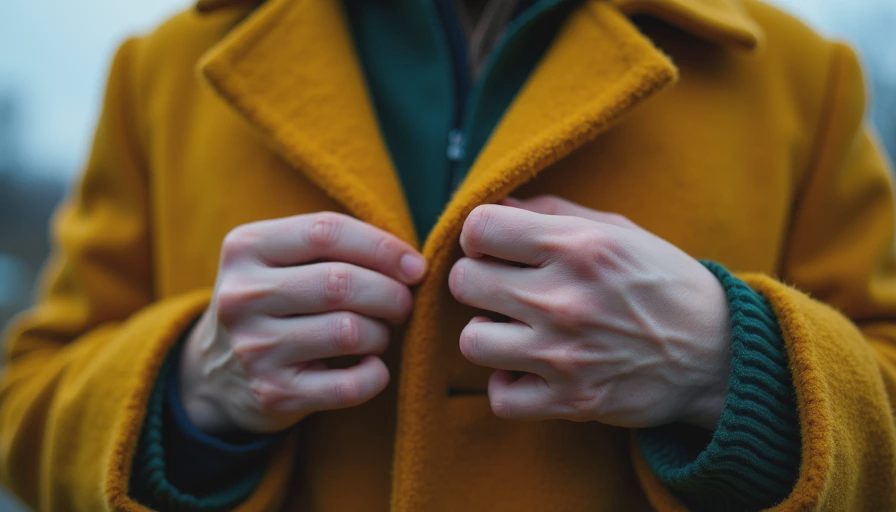
Flip It Inside Out
This is the test most people skip, and it tells you more than any other step. Turn the garment inside out and look at the seams. Are they finished with a serged edge, or are they raw and fraying? Do the seams lie flat, or do they pucker at every curve? A garment with a clean, straight seam and a 5/8-inch seam allowance is meant to be altered and worn for years. A blind-stitched hem on a pair of trousers is a sign of care; a rushed blind hem is not.
I also check the yoke of a shirt — the seam across the shoulders. In a well-made shirt, the plaid or stripe pattern matches up at the shoulder seam. That's the kind of detail that costs the manufacturer time, and they'll only spend it if they expect you to keep the shirt for a long time. If the pattern is off by half an inch, you're looking at a garment made down to a price, not up to a standard.
Buttons, Holes, and Zippers
Small hardware tells the story. Real-wood or corozo buttons feel solid in your hand; plastic buttons are often hollow and light. Inexpensive garments often use buttons that are merely stitched on once with a bit of thread that wiggles. Give any button a gentle pull. If it moves more than a quarter of an inch, it'll pop off in the first year.
Buttonholes should have tight, continuous stitching and be reinforced with gimp thread — that's the little cord inside a proper bound buttonhole. On a quality jacket, the buttonhole on the lapel is actually functional and hand-finished. Zippers are just as telling. Look for a YKK zipper or an equally reputable maker, and run it up and down a few times. A good zipper is smooth and quiet; a cheap one catches, feels sticky, or leaves tiny metal shavings.
What the Lining and Hem Reveal
A lined garment will keep its shape, whether it's a blazer, a skirt, or a handbag. When I'm evaluating quality clothes, I peek at the lining fabric. Genuine Bemberg rayon is a hallmark of a higher-end garment, while a generic polyester lining tends to be shiny and sweaty against the skin. For coats and blazers, a sleeve lining is important too — unlined sleeves stick and bunch up when you put the coat on, so a little lining makes the difference.
The hem is another clue. Turn over the bottom of a pair of trousers: a fine-quality hem is pressed flat and hand-stitched so it doesn't show through on the outside. The stitching on a denim hem should be even and neat, with a finished chain stitch that doesn't unravel. These are details most people never think about, but they decide how the garment hangs after you break it in.

Read the Care Label Like It Matters
The care label is not just legal boilerplate. Learning how to spot quality clothes starts with what the manufacturer is willing to tell you about care. If the manufacturer tells you to dry clean a cotton dress, that tells you the seams are fragile and the fabric hasn't been pre-shrunk. That's fine for a special occasion dress, but for a piece you'll wear weekly, you want easy care: machine-washable cotton, denim, or a technical knit that won't pill.
Quality isn't about cost per piece, it's about cost per wear. I keep a running tally on my phone for anything over $100. A $180 pair of trousers you wear 120 times costs $1.50 each time you put them on. A $40 budget pair you wear 6 times costs $6.67 a wear. Once you start doing this math, shopping changes entirely. You stop asking "is this expensive?" and start asking "is this worth it?"
The Bottom Line: Buy the Construction, Not the Label
If you take one thing from my years as a buyer, it's this: the next time you're in a store, slow down by thirty seconds. Feel the fabric, turn the garment inside out, check the buttonhole, and glance at the care label. If those things pass, the brand name barely matters. If those things flunk, the label will not save you.
So yes, knowing how to spot quality clothes takes a little practice. But once you develop the habit, it becomes automatic — and your closet will be full of pieces that actually make it to year five. Wear it and go.


No notes yet — write the first one.